WOCU-Monitoring continues to evolve to meet the challenges of monitoring increasingly complex IT infrastructures.
Across Releases 70 to 74, we have introduced new capabilities that expand what the platform can offer: from more flexible and secure administration to advanced observability tools, AI-assisted analysis and predictive monitoring.
These improvements enable IT teams to gain a more complete view of their infrastructures, detect anomalous behavior, anticipate potential performance issues and simplify administration and troubleshooting tasks.
In this article, we look at the most significant advances and how they contribute to more proactive, efficient and intelligent monitoring
AI-Powered Observability
WOCU-Monitoring extends its traditional monitoring capabilities with a new Observability module, enabling deeper analysis of infrastructure behavior and making incident investigation easier.
The introduction of AI Assistant enables users to ask questions about operational information in natural language, while the Ask AI about a problem action provides contextual assistance when analyzing problems detected in Hosts and Services.
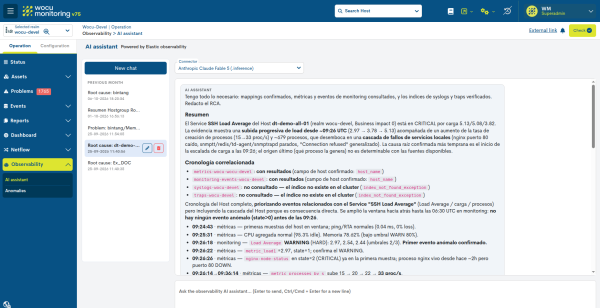
These capabilities help IT teams speed up troubleshooting, better understand incidents and reduce the time spent investigating them, bringing AI-assisted analysis into everyday monitoring workflows.
Predictive Monitoring: Anticipating Problems
WOCU-Monitoring takes a further step towards proactive monitoring with tools that help detect deviations and anticipate potential performance issues.
The new dynamic thresholds analyze historical metric behavior to identify anomalous values, going beyond the limitations of traditional static thresholds.
Meanwhile, Metrics Forecast makes it possible to visualize the predicted evolution of metrics over the next 24 hours, helping teams spot emerging trends that could affect system performance or capacity.
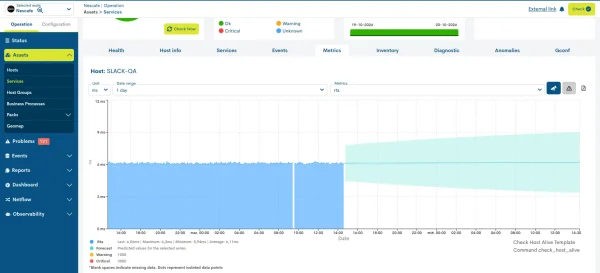
Together, these capabilities help IT teams move from reacting to incidents to making preventive, data-driven decisions.
Advanced Anomaly Analysis and Infrastructure Health
Understanding the state of an infrastructure requires more than knowing whether its devices are available. It is essential to identify unusual behavior and have information that supports diagnosis.
WOCU-Monitoring introduces advanced anomaly detection and analysis capabilities, making it possible to identify deviations from expected metric behavior and investigate their impact at different levels: Realm, Host and Service.
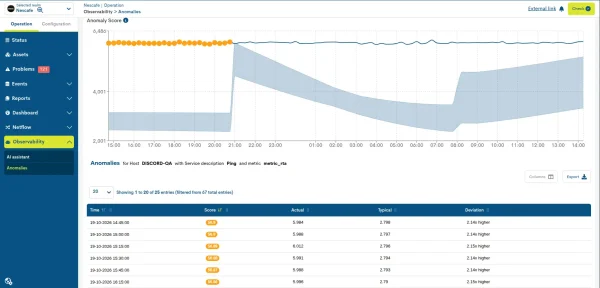
Through the Anomalies view, IT teams can review and filter detected anomalies, assess their relevance and investigate the affected elements in greater detail.
These capabilities are complemented by the new Health dashboards, which provide a consolidated view of the operational status of network devices, organizing availability, resource, connectivity, capacity and quality indicators.
Together, these tools provide greater visibility into infrastructure health and make it easier to identify and diagnose anomalous behavior.
More Flexible and Customizable Dashboards
WOCU-Monitoring expands dashboard visualization and customization options to meet the operational needs of each monitoring environment.
The introduction of new HTML and Markdown widgets makes it possible to integrate technical documentation, diagrams, links, operational procedures and other customized content directly into monitoring dashboards.
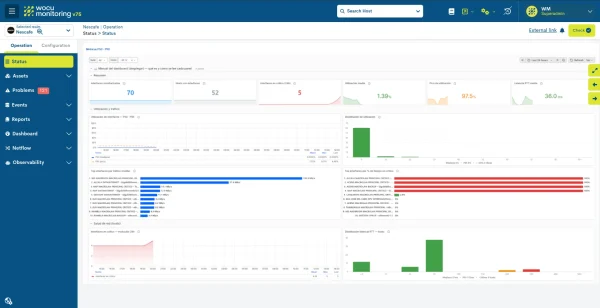
In addition, improvements to interactive metric visualization, including time-range selection and zoom functionality, make it easier to explore data and analyze trends.
These capabilities enable more complete, flexible dashboards tailored to each team’s needs, combining monitoring information with useful resources for day-to-day operations.
Automation and Integration with Other Systems
WOCU-Monitoring continues to expand its automation and integration capabilities to simplify the administration of complex environments and make monitoring information accessible from other platforms.
Automated Observability provisioning simplifies the setup of new environments by automating the configuration and preparation processes for the resources required to enable observability capabilities. This reduces manual intervention and speeds up deployment.
In addition, expanded monitoring APIs make it easier for external applications to retrieve historical metrics, events and state changes, supporting integration with analysis, reporting and automation tools.
These capabilities help reduce deployment complexity, improve interoperability and make monitoring data available to other corporate processes and tools.
Secure and Centralized Administration
The evolution of WOCU-Monitoring is also reflected in simpler, safer and more efficient management of monitoring environments.
User administration by Realm allows users, roles and permissions to be managed independently, supporting access control and the administration of multi-customer infrastructures.
New bulk configuration options also make it possible to apply changes to multiple devices at once, such as enabling dynamic thresholds or SNMP inventory collection.
These improvements provide greater administrative autonomy, reduce repetitive tasks and simplify the management of large-scale infrastructures.
Moving Towards Smarter, More Proactive Monitoring
The evolution of WOCU-Monitoring reflects our commitment to developing a platform that meets the needs of increasingly complex and demanding IT infrastructures.
By introducing new observability, artificial intelligence, predictive analysis and automation capabilities, we enable IT teams to go beyond traditional monitoring towards more proactive, efficient and data-driven operations.
We continue to move towards monitoring that not only shows what is happening across the infrastructure, but also helps teams better understand its behavior, anticipate potential problems and resolve them more quickly.
Discover these capabilities and the latest WOCU-Monitoring updates in our official documentation.